
Not long ago, a podcast was a straightforward proposition: two microphones, a conversation, and an audio file uploaded to a feed. Audiences listened. Hosts recorded. The medium was almost entirely sonic.
That is no longer the world most podcasters are operating in. Video podcast production has shifted from a niche experiment to a mainstream expectation, driven primarily by the rise of YouTube as a podcast platform and the clip-based content economy that TikTok, Instagram Reels, and YouTube Shorts have created.
For podcasters, this shift raises a real question: does a show need video to compete in the current landscape? And for those who decide to add video — what does that actually require in terms of production?
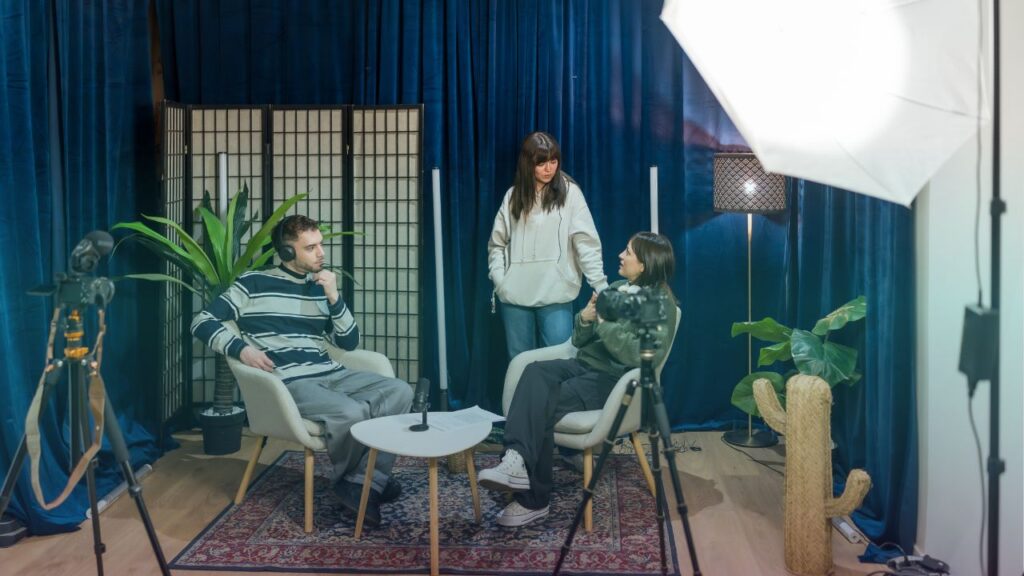
At Canadian Podcasting Productions, we produce podcasts with full audio and video production for in-person and remote guests. We’ve watched this shift unfold in real time, and we’ve built our production process around what audiences now expect. Here’s what we’ve learned.
How Audience Expectations Have Shifted
The most significant driver of this change is not technology — it’s platform behaviour. YouTube has become one of the largest podcast platforms in the world. Spotify has been investing heavily in video podcast capabilities. And social media platforms have trained audiences to consume content in short, highly visual clips that are almost always derived from longer video sessions.
The result is a new set of baseline expectations that many audio-only shows are struggling to meet — not because their content is worse, but because the way audiences discover and evaluate podcasts has fundamentally changed.
When a potential new listener discovers a show through a 60-second clip on Instagram or a YouTube Short, their first experience of that show is visual. The host’s presence, the quality of the production, the physical environment — all of these communicate something about the show before a single word is processed. An audio-only show simply does not exist in that discovery pathway.
What Video Has Changed About How Audiences Evaluate Podcasts
Credibility is now partly visual
In an audio-only environment, credibility is communicated almost entirely through voice, content, and guest quality. In a video environment, the host’s physical presence, the production setting, the quality of the lighting and framing, and the visual energy of the conversation all contribute to how credible and trustworthy the show feels.
This is not superficial. It is the same dynamic that makes a well-produced television interview feel more authoritative than the same conversation recorded on a phone. The production signals the seriousness of the content.
Discovery has become clip-driven
The podcast clip — a 30 to 90-second excerpt from a longer episode — has become the primary unit of podcast discovery on social media. For a clip to perform well on Instagram Reels or YouTube Shorts, it almost always needs to be video. A static image or audiogram can work, but it competes at a significant disadvantage against native video content in algorithmic distribution.
Shows that are produced with video can repurpose every episode into multiple discovery assets. Shows that are audio-only are restricted to formats that the current social media landscape does not prioritise.
Audience relationship depth increases with video
Listeners develop strong parasocial relationships with podcast hosts — it is one of the defining characteristics of the medium. Video deepens those relationships further. Seeing a host’s facial expressions, body language, and physical reactions to a guest’s answers creates a richer sense of connection than voice alone.
For shows built around personality, expertise, or community — where the host-audience relationship is central to the show’s value — video is not just an add-on. It is a meaningful upgrade to the core product.
Audio vs. Video Podcasting: What’s Actually Different
The decision between audio-only and video is not simply a question of adding a camera. It affects how a show is produced, how it is distributed, and how much post-production work each episode requires. Here is an honest comparison:
| Audio-Only Podcast | Video Podcast |
| Listener builds their own mental image of the host | Viewer builds a real relationship based on visual presence and body language |
| Works well during commutes, exercise, and chores | Primarily consumed at a desk, on a tablet, or a connected TV |
| Clip-ability limited to audiograms and quote cards | Clips translate directly to YouTube Shorts, Reels, and TikTok |
| Production quality judged almost entirely on audio | Production quality judged on audio, lighting, framing, and environment |
| Guest credibility communicated through voice and content | Guest credibility also communicated through appearance, setting, and energy |
| Easy to produce remotely with good microphones | Remote production requires significantly more technical coordination |
| One deliverable per episode (audio file) | Multiple deliverables per episode (full video, short clips, thumbnail, chapters) |
The Production Challenge Nobody Warns You About
Adding video to a podcast is not as simple as setting up a camera and pressing record. The production challenges multiply — particularly when remote guests are involved.
Consistency across in-person and remote guests
One of the most common production problems we see in video podcasts is visual inconsistency between the host and their guests. The host is well-lit, well-framed, and recorded in a controlled environment. The remote guest is lit by a window, using a laptop camera, and sitting in front of a cluttered background.
The result is a show that looks professional in one half of the screen and amateurish in the other — which undermines the overall quality perception of the entire episode. Managing remote guest video quality is a production problem that requires a clear technical process and, ideally, guidance provided to guests before they record.
Audio quality does not automatically improve with video
There is a persistent misconception that switching to video production will prompt creators to invest in better audio. In practice, the opposite sometimes happens: attention shifts to the visual elements and audio quality is neglected. A video podcast with poor audio is harder to watch than an audio-only show with poor audio — because the visual presence of the host or guest raises expectations that the audio then fails to meet.
Post-production time increases significantly
An audio-only podcast episode requires editing, mixing, and distribution. A video podcast episode requires all of that plus video editing, colour correction, thumbnail design, chapter markers, and the creation of short-form clips for social distribution. For teams without dedicated production support, this workload is often what leads to shows going on indefinite hiatus.
Should Your Podcast Add Video? An Honest Framework
The answer is not the same for every show. Here are the questions worth asking before making the decision:
1. Where does your audience spend time? If your target audience is active on YouTube, Instagram, or TikTok, video opens a significant discovery channel. If they primarily listen during commutes or workouts, the urgency is lower.
2. Is your show personality-driven or content-driven? Shows where the host-audience relationship and guest chemistry are central to the value proposition benefit most from video. Highly technical or educational shows where the content is the primary draw may find audio-only still serves their audience well.
3. Can you maintain the production standard consistently? A video podcast that looks professional in some episodes and poor in others damages the show more than an audio-only podcast with consistent quality. If you cannot maintain video production standards across every episode, it is worth either investing in production support or delaying the addition of video until you can.
4. Do you have the post-production capacity? The workload of a video podcast is significantly higher than audio-only. If your team does not have the bandwidth to handle editing, clipping, and social distribution consistently, a production partner is almost always more cost-effective than building the capability in-house.
5. What does your current audience expect? If you have an established audio audience, survey them before making the switch. Some audiences actively prefer audio-only. Understanding your current listeners’ preferences is at least as important as chasing new ones.
What High-Performing Video Podcasts Do Differently
Across the shows that are growing their audiences in a video-first landscape, several consistent patterns emerge:
• They treat every episode as a multi-platform content asset. The full episode is one deliverable among many. Short clips, highlight reels, and audiogram versions are planned before the episode is recorded, not as an afterthought.
• They maintain consistent visual production standards. Lighting, framing, background, and on-screen titles are consistent from episode to episode — building a recognisable visual identity that reinforces the show’s brand.
• They invest equally in audio and video. The shows that succeed with video are the ones that understand that adding a camera does not replace the need for excellent audio. Both elements are taken seriously from the start.
• They manage remote guest quality proactively. Guest setup guides, pre-recording technical checks, and clear expectations about microphone and camera standards are built into the production process — not addressed after a poor-quality episode has already been recorded.
The Canadian Podcasting Productions Perspective
We produce podcasts with full audio and video production — and we have built our process around the reality that both elements require equal care and attention. A show that sounds excellent but looks inconsistent leaves value on the table. A show that looks great but has variable audio quality will lose audience trust over time.
Our production process covers everything from pre-recording guest guidance through to post-production editing, clip creation, and episode delivery. Whether your show features in-person guests, remote guests, or both — we ensure that every episode meets the same visual and audio standard.
Because in a landscape where audiences are forming their first impression of your show through a 60-second clip on social media, the production quality of that clip is not a detail. It is the whole first impression.
Final Thoughts
Video podcasting is not a trend that is going to recede. The platforms driving it — YouTube, Spotify, Instagram, TikTok — are investing heavily in video-first podcast infrastructure, and audience discovery habits are adapting accordingly.
For podcasters, the question is not whether video matters. It is whether your show is ready to meet the production standard that video requires — and whether you have the right support to do it consistently, episode after episode.
The shows that will define the next generation of podcasting are the ones that take both the audio and the visual seriously. Not as separate considerations, but as two elements of the same craft.
Thinking about adding video to your podcast, or starting a new show with professional production from day one? Talk to the Canadian Podcasting Productions team about what that looks like in practice.